Work is continuing on listing archives material and as collections are catalogued this page will be updated

Grand Jury
The Grand Juries were made up of large landowners who were charged with meeting with others, like Justices of the Peace, to assess proposals from presentment sessions. These presentments could include issues in relation to building and repairing roads, construction of courthouses, and so forth, as well as the support of schools, hospitals and prisons. These services were paid for through a Grand Jury Cess, a rate paid by the occupiers of the barony. Grand Juries met only twice a year at the local courthouse where they considered presentments at Spring and Summer Assizes. At these sessions works to be considered, for example, were put forward, with a list of contractors, the value of the contract, and details of the extent of work to be done. As a result, the records of the Grand Jury provide evidence of some of the earliest public works in the county. Under the Local Government (Ireland) Act 1898, County Councils replaced the Grand Jury system which were seen as no longer suitable to administer local schemes.
Other records:
Contract for Galway Jail (1815)
Treasurer's query books detailing discharged and undischarged presentments (1819-1878) – with some gaps
List of Quarter Sessions (1850)
Poor Law Union records
Poor Law Unions (PLU) were established under the Poor Law (Ireland) Act 1838 in a response to widespread poverty. The Board of Guardians performed the role of administrators of the workhouse and the relief of the poor, overseeing the management of staff, budget and accounts. The Master and staff of the workhouse preformed the practical duties day-to-day. After 1847 half the members of each Board held office ex-officio, these included local magistrates or large landowners, for example, while and the other half were elected. All those with property valued at over £4 were entitled to vote. A local rate levied on each Union provided for the upkeep of paupers in the workhouse who were sometimes called inmates. While workhouses were not prisons the regime was prison-like; paupers could make the decision to leave whenever they wished, but many were admitted because they had nowhere else to go.
Workhouse Registers
The County Archives collection of admission and discharge registers are extent for Castlerea Workhouse for the period 1878-1889. They tell the story of the poor and destitute of the county and highlight details about their lives and the social conditions of the time.
The headings in the registers include:
Number
Name of pauper
Sex
Age
Statues (i.e. single, married, widow. If a child, status of child)
Employment
Religion
If disabled, nature of disability
Name of wife/husband
Number of children
Condition on entering the workhouse
Electoral division and townland
Date admitted or when born in workhouse
Date of death/discharge
Board of Guardian Minute Books
Minutes are the largest series of records in relation to Roscommon Workhouses, of which there were four: Boyle, Castlerea, Roscommon, and Strokestown. They provide an overview of the operations of the Board but also a glimpse of what life was like for paupers. The reports of the Master and Medical Officer are of particular interest. It is useful to know that summary reports of Board meetings in local newspapers are helpful where gaps in official minutes exist.
Boyle Union Minutes (1883-1921)
Castlerea Union Minutes (1839-1923)
Roscommon Union Minutes (1886-1921)
Strokestown Union Minutes (1850-1921) Part of Strokestown Board of Guardians minute books are digitised for 1920-1921:
Other records:
Register of Boyle PLU Financial Statements (1907-1927)
County, Town & Rural District Councils
Roscommon County Council was established after the passing of the Local Government Act 1898. The Act resulted in changes to the county boundaries so that the Ballaghaderreen and Edmonstown electoral divisions were transferred to Roscommon from County Mayo, the electoral divisions of Rosmoylan transferred from County Galway, half of Athlone transferred to County Westmeath, and part of Ballinasloe transferred to County Galway. As well as these changes, the Act also had serious consequences for the role of the Grand Jury and Boards of Guardians in local decision making.
The County Council Minutes provide a fascinating view of operations and development in the county and contain a wide range of information. They are an important, official account of the work of the Council, but also reflect local decision-making, heritage, identity, and politics.
Roscommon County Council
Minute Books (1899-2025) - digitised for the period 1911-1927
Other records:
Records reflecting corporate governance include Chief Executive orders, annual reports, policies, strategies, and development plans. Additionally, Council Archives include planning and development files, housing records, material relating to finance and procurement, roads, infrastructure and environment, community, heritage, libraries, culture, the arts, personnel and administrative records, as well as those that set out legal and regulatory responsibilities like by-laws, licencing and court-related records.
Generally, records are transferred to archival custody and made publicly accessible after 30 years, provided there are no legal or confidentiality restrictions.
Rural District Council
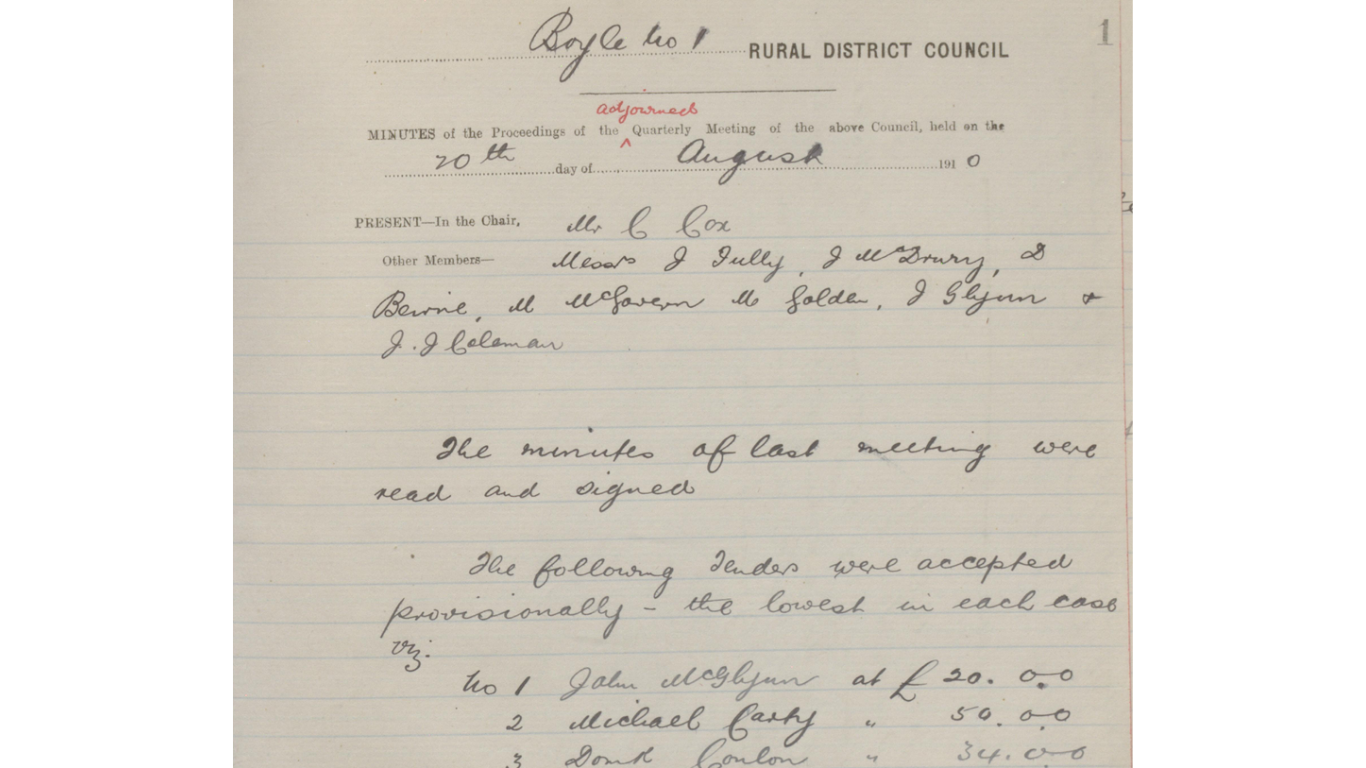
Minute Books:
Athlone (1899-1926) - digitised 1910-1913
Boyle (1899-1925) – digitised 1910-1925
Carrick-on-Shannon (1903-1916)
Castlerea (1901-1925)
Roscommon (1899-1923)
Strokestown (1899-1920)
Town Commissioners
Minute Books:
Roscommon Town Commissioners (1858-1937)
Other records:
Rough Correspondence Books (1874-1937)
Rough Copy Orders (1910-1970)
Letters (1908-1915)
Account Book (1874-1920)
Boards of Health and Public Assistance
The Board was formed under the Local Government Act, 1925, to take over administration of public health for the county, as well as some of the functions of the abolished Rural District Councils. These functions included the building of rural cottages, and the provision of water supply and sewerage schemes. In 1942 the Boards were abolished. Some of these records contain sensitive and personal information and restrictions on access apply.
Minute Books
Minutes of Board of Health Public Assistance 1924-1942. Some of these records contain sensitive and personal information and restrictions on access apply.
Registers of Interment
The earliest existing register dates from 1911 for Taughmaconnell. These registers often, but do not always include the section location where interred. Some restrictions to access exist, in particular where information about the grave owner or living persons are recorded. In these cases, the archivist will redact, as appropriate. Use is allowed for personal research or educational purposes only. Registers exist for the following:
Arigna Old & New 1948-2016
Assylinn 1970-2017; 1946-1973
Athleague 1958-2018
Aughrim New 1949-2016
Ballinagare (Drumlin) 1953-2016
Ballinderry 1953-2016
Ballinlough 1947-2017; 1948-2014
Ballintubber 1946-2020
Caldra 1953-2014; 1953-2017
Clonowen 1923-2015
Clonower 1917-1942; 1947-1983
Cloonburreen 1937-1967
Clooncraff 1963-2017
Cloonshanville 1946-2001
Cloontuskert 1975-2016
Derrane 1981-2007
Drumlion 1952-2018
Dysert 1943-1997; 2001-2017; 1947-2005
Eastersnow (Croghan, Boyle) 1970s
Elphin New 1970s
Fairymount 1916-2013 (fire damaged)
Fuerty 1978-2016
Gailey 1948-2012
Gortaganny 1968-2016
Kilbarry 1962-2018
Kilcolman 1978-2007 new exctension; 1946-1972;2000
Kilcolman 1972-1982; 2007-2017
Kilcommon 1946; 2007-2017
Kilcooley 1955-2011
Kilgefin 1976-2007
Kilglass 1963-2012; 1999-2015
Killapogue 1948-2018
Killelan Old & New 1966-2013; 1985-2013
Killina New & Old 1952-2017; 1957-2010
Killukin 1948-1980
Kilmaryal 1970
Kilmore 1963-2016
Kilnamanagh 1958-2000
Kilronan New 1972-2009
Kilronan 1963-2017; 1986-2018
Kilrudden 1945-1994
Kiltoom 2003-2016; 1933-2005
Kiltrustan 1963-2018
Moore 1965-1995
Moore Extension 1997-2016
Ogulla 1948-2018
Oran 1996-2017; 1944-2015
Rahara 1973-2017
St Joseph's Castlerea 1984-2018
Taughboy 1947-2008
Taughcamonnell 1915-1933
Taughmaconnell 1911-2017
Tibohine 1982-2016; 1947-2016
Tisrara 1952-2017
Private Papers
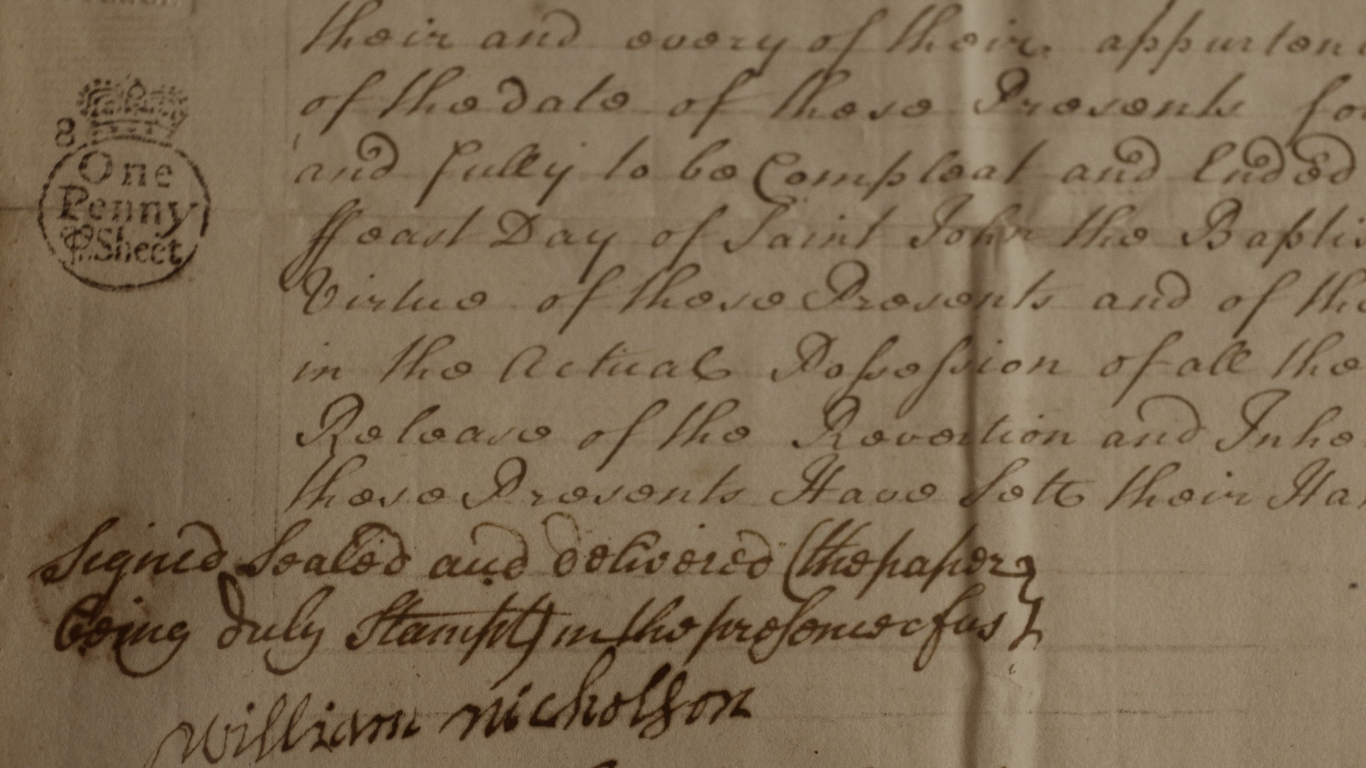
As well as records of the local authority, that are over thirty years old and in various formats, the Archives also collect other material including private papers - architectural drawings, solicitors’ papers, maps and plans, photographic collections, film, and sound recordings, and other relevant material.
Some private collections (like School Rolls) are closed and access restricted due to their sensitive content and/or the wishes of the donor.
The Archives includes some of the following collections of private origin:
- National School Rolls, Registers and Daily Report Books
- Lloyd Papers (Estate maps, rentals, and accounts)
- Crofton Papers (Estate maps, rentals, and accounts)
- Lorton Papers (Indentures)
- Tenison Papers (Estate maps, and related)
- Gately Papers (Photographic material and letters)
- O’Farrell Papers (Indentures and family genealogy)
- Cox-Bodkin Papers (closed on the wishes of the donor until 2048)
- Douglas Hyde Papers (spcecial collection material of books, letters, and other related)
- Liam Mannion Papers (photographs and related material)
- Brighid Coleman Papers (correspondence and photographic material)
- Lucy Kurtz Papers (sketches and drawings)